Wednesday, April 28, 2010

The 'L' Word


We've all been there, your with someone, you've been on going out for a while now, and it hits you. You have the feeling to say the 'L' word. But what if it's too soon to say that, or maybe they never have or will love you? All these thoughts fly by in an instant and it slips out, 'I love you.' Now you've done it and you can't take it back. So, do they tell you the same thing, or feel uncomfortable and leave, never to return again? I suppose that all depends on the person...


In 2005 1,181 women were murdered by an intimate partner (that's about 3 women per day!)But for women who profess their love between the ages of 15 to 24 are at the highest risk to be murdered by their lover if they leave them. But for women between 25 to 34 this percentage drops by 25%, and keeps declining as they get older and older. According to David M. Buss, he believes this is because younger women are more fertile, reproductively valuable, and this leads to a greater reproductive loss for the man if she left him. And from the man's perspective, he loses his mate, and that loss becomes a rivals' reproductive gain. This, he says, we learned from evolution. I don't necessarily disagree with that claim, but I think it's a bit more than that.


We all had our first real relationship, that one we thought would last forever, only to be left heartbroken when they left for one reason or another. I think what makes girls ages 15 to 24 at such a higher rate of being killed by an angry ex is because when we are in our teens and early 20's that our first time for a lot of things-love being one of them. I think that when someone has never had a broken heart before, some of us can pick up the pieces, get over it, and move on to someone else, but some just can't. I think this is what leads men to killing their ex. Because who do you know that just had their relationship end say, 'I'm gonna get her back because her reproductive value is very high.' ? I sure haven't heard that one before, but maybe I just associate with primitive people? Wait.....?

Sunday, April 18, 2010

The Best and Worst Cities in the US

So, reading my book it made me look over my shoulder a bit more actually. I don't have any past ex that's out to get me (Well, as far as I know), but I still get that sixth sense feeling sometimes. But which cities are the safest and really have no need to constantly look over your shoulder, and which ones are cities where you could get caught in the crossfire?
The most recent data I could find was from 2007, and it listed the top 25 safest cities and the top 25 most dangerous ones in the United States. Do you want to live in the safest town in the nation, where everyone has big green lawns, with big houses that look exactly the same, and all that jazz? Well the number one safest city in the US (as of 2007, keep in mind) was Mission Viejo, California. But don't worry if you live way over on the east coast, the list was fairly spread out over the entire nation-although there wasn't any mid-west cities in the top 25.
So, what city was rated worst in safety? And the winner is.....Detroit, Michigan! Woo Hoo!-wait, that's not a good thing. If you are currently living in Detroit, it might be a good idea to pack your bags and head to California. Actually Michigan seems like a somewhat dangerous place to live, because Flint, Michigan was rated number 3 in most dangerous place to live. But there were a few cities in Michigan that rated in the top 25 safest places to live. So it's a hit or miss I guess. Another interesting thing I noticed was that Kansas City, Mo. was rated 13 on the danger side, and Kansas City, Kansas was rated 25. So if you want to be a little safer, just head to the other side of the border, there's some barrier that keeps people more docile on the Kansas side.
Actually, now that I think of it, Micheal Moore did a documentary on firearms titled Bowling for Columbine. An interesting fact-Micheal Moore is from Flint, Michigan, so maybe he's a dangerous man? He also explain in the documentary that although Detroit is such a violent city, right on the other side of the border in Canada people are so unafraid of violence that they leave their doors unlocked at all times. Now, I've never been around Canada opening up random doors, so I have no idea if this is true, or in Moore opened many different doors and only put in the ones that were unlocked. Either way, I'm fairly sure Canada isn't as violent as the US.
If you want to see all the cities that made the list here's the link.

Monday, April 12, 2010

Beauty is more than skin deep...?


Many homicides that occur are about a man who discovers that his wife is going to leave him, or cheated on him, etc. But what exactly captivated the man into falling in love with his wife? Well, we all know the old saying 'beauty is more than skin deep' which I find to be very true but what initially gives us the curiosity to walk up to someone and start a conversation? Is it their intriguing personality? I don't think so, only because you've never actually talked to them before!
I had learned last year in my AP Psych class that people are subconsciously attracted to those who have a very symmetrical face and body. This was also mentioned in Murderer Next Door talking about how the genes are passed on more by symmetrically faced people. (Take a look at the picture and tell me which one do you find more attractive?)
But as I read, to me it seems like an odd thing to claim. We all like different things, one girl may love a guys haircut, and the next finds it ugly and unattractive. Or one guy may like girls with smaller noses and another be subconsciously more attracted to women with slightly larger ones. But this article from the Telegraph in the UK makes a slightly different claim. They say that symmetry of physical features isn't something that makes us more attracted to someone, it instead tells us that that person is more fertile, or has a better ability to pass on offspring. Whether or not that's true-well, I'll just leave that up for you to decide because we are all different people with different likes and dislikes.

Thursday, April 1, 2010

Gotcha! How they catch Serial Criminals


So, how exactly do you catch a criminal? Hope his face is on camera? Or maybe he felt so guilty after committing the crime he just turned himself in? Both are very unlikely, but according to this article from Psychology Today, law enforcement relies heavily on a signature.


There are three key elements that help law enforcement catch a criminal: 1.M.O. (Which is a set of skills a criminal will use to find his victim. Such as going to a park at night when there aren't many people to find a victim) 2.Victimology (That uses characteristics-gender, age, race, etc-of the victim to asses a certain 'type' that the killer tends to gravitate toward) 3.Signature (This is something that is unique to each person) With these three things they can more accurately predict who the criminal will go after and where he might be next.


Unfortunately, victimology can sometimes be unreliable or inconsistent, so it is used as an aid rather than a leading way to solve a crime. A killers' MO can also evolve. It can evolve because all it is is a set of learned traits-such as commiting their crime at night because it is easier to not be spotted. But as they commit more crimes they might find doing something different than what they did in the beginning is easier to do, so they change their MO. But the Signature is what should always stay the same over time. As the article states, a signature could be when a killer dumps the body stripped of their clothing and in a public place to cause humiliation. Although, in the end, it is a combination and use of all three elements-MO, Victimology, Signature-that help catch the killer and put him to justice.

Do we Inatley know how to Kill?

In The Murderer Next Door Buss explains that he is a believer in evolutionary psychology, and thinks a lot of our traits we have are there because we acquired them from our ancestors through evolution. According to psychology our most basic goals in life are to survive which ultimately will let us reproduce to pass on our traits. So, overtime as those traits that help people kill get passed on (whether it be more physically able than the average person or smarter, etc), So, according to Buss, we are born naturally to kill, just because in the past killing was sometimes how you secured a spot with a mate to reproduce offspring.

But things are different now, we have more rules. You go to jail if you commit homicide, and everybody looks down upon you. So you face ostracism because murder isn't something 'normal' people do, we have to be a bit more clever than just killing anyone who is vying for the same mate.

As stated before, there are many barriers that deter people from killing-possible guilt afterward, ostracism, or jail. Of course sometimes we perceive to have no choice but to kill to solve a problem. I think most of the time we think that killers are crazy people where something was screwed up in their head, yet most of the people who commit homicide are deemed to have no mental instabilities and had premeditated the murder. It's because sometimes I think-although it's hard for us to think of-that they see no other plausible way out. Consider a man who thinks his wife is cheating on him. Then he eventually finds out it was true, she was sleeping with other men. She promises to change, that she was weak but she truly loves him with all her heart, yet the man doesn't quite believe her. He gives her the chance but something, to him, still doesn't feel right. He doesn't trust her, and unfortunately finds out again that she was cheating on him, and now feels there is no other way to take except murder. So, the man, angry that his mate isn't bearing his offspring, feels that since she isn't trustworthy must take action. Although to us, it may not seem normal or logical to us, sometimes that how it plays out.

Exterminating any competition also has a multiplied effect than just being dead-similar to the Keynesian models in economics. That is, it is obviously bad to be dead, we all know that. But if we are dead (or unfortunately murdered), not only are we dead but we are unable to protect any children we've already had, and we can no longer produce any more, and our widowed spouse also can hook up with another mate. Thus, all our genes that would've been passed on are either exterminated on the spot, or-if we had had children already-are severely weakened because they no longer have a parent to protect them. So, it might be a good idea to not get killed.

Monday, March 29, 2010

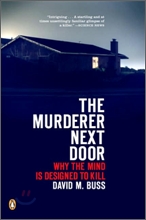
The Murderer Next Door


I have just begun reading a book titled The Murderer Next Door: Why the Mind is Designed to Kill by David Buss. This book is-from what I know-trying to explain that killers aren't typically what we think of. That being, most murderers are not someone who has been locked up before, because they are such a 'hardened' criminal. Actually, Buss argues that most people who commit murder are what most people would call 'normal', but through certain circumstances and traits we as humans evolved into, we commit a murder.

But who is David Buss, why does he matter and what has he done? Well, David Buss earned a Ph.D. in psychology at Berkeley and is currently a professor of Psychology at The University of Texas in Austin, but he has been an assistant professor at Harvard for four years and a professor at the University of Michigan for eleven years. He has written many papers and some books, and he has received awards for his writings-so this guy is definitely the real deal. So, I'll be giving updates periodically on what he's talking about in the book and what I think about his it.

Thursday, March 18, 2010

First Impressions Video


So here is a video about first impressions. If you like guessing, then you can go to youtube.com and key in 'first impressions' and find videos just like this with different people.